
Should a Local Business Have a Bilingual Website? What to Know Before You Build One
2026-10-07 · by Lin Zeri
If some of your customers speak Spanish at home, sooner or later someone suggests a Spanish version of your website. It sounds simple: add a language button, translate the pages, done. In practice, a second language is a small publishing project. It needs real content, a clear structure, and someone who keeps it current.
This guide helps you decide whether a bilingual website fits your business, and what to settle before you build one. It does not promise that a second language will raise your sales. The data on that question is thinner than most articles pretend, and we will be clear about what it does and does not show.
Key Takeaways
- A bilingual site makes sense when a real share of your customers is more comfortable in Spanish and you can keep that version accurate and current.
- Google reads the language of a page from its visible content, so each language needs its own page written in that language.
- Language versions must point to each other. If two pages do not point back and forth, Google ignores the markup.
- The available numbers describe preferences and media habits, not proof that a Spanish page will convert better. Treat them as context, not a forecast.
Who Actually Needs a Bilingual Website?
Start with your customers, not with the trend. A bilingual website is worth considering when the people who call, text or walk in are not all comfortable doing business in English.
Some signs that point that way:
- Customers ask you questions in Spanish on the phone, by text or at the counter.
- Your crew or front desk already switches languages during the day.
- Family members call on behalf of a parent or relative who prefers Spanish.
Some signs that it can wait:
- Nobody has ever asked for anything in Spanish.
- You have no one who can write or review Spanish copy, and no plan to get that help.
- Your English site is still thin, outdated or slow. A second language multiplies those problems instead of fixing them.
If you cannot answer Spanish-speaking customers when they respond to the page, the page promises something you cannot deliver.
What Does the Data Say About Language and Buying?
There are three public numbers worth knowing, and each one has limits. Read the caveats before you quote any of them to a partner or a web developer.
How many people speak another language at home. Over three-quarters (78.3%) of Americans age 5 and older spoke only English at home in 2018 to 2022. Among those who spoke another language, 61.1% spoke Spanish. The release does not give a total for the group that speaks another language, but by subtraction it is about one in five people. And 61.0% of Spanish speakers said they spoke English "very well" (U.S. Census Bureau, 2023, accessed Oct. 2026). These are national figures. They say nothing about your city or your customers.
Read that last number as an inference, not a finding: speaking English well does not tell you which language a person prefers when choosing a business. You cannot guess it from an accent or a last name, which is the argument for offering the choice.
How Hispanic adults get their news. In 2024, 54% of Hispanic adults said they get news mostly in English, 21% mostly in Spanish, and 23% said they consume news in both languages about equally (Pew Research Center, 2024, accessed Sept. 2026). This is about news, not shopping or search. What it does show is that many people move between both languages, so "Spanish speaker" and "English speaker" are not two separate groups.
What shoppers say they prefer. A 2020 global survey of 8,709 online consumers in 29 countries found that 76% prefer to buy products with information in their native language, and 40% said they will never buy from websites in other languages (CSA Research, 2020, accessed Sept. 2026). Keep the limits in view: the survey is global, it is from 2020, and it measures stated preference, not what happened after a business added a language. It is not a US local-services number, and it is not evidence that adding Spanish will raise your leads.
Put together, the honest reading is this: many of your customers may be comfortable in either language, some will lean toward one, and giving people the choice removes a barrier you may not see. None of this tells you how much business a Spanish page will bring in. If an article gives you that number without a source, be skeptical.
When Does a Second Language Version Make Sense?
A useful test is to ask three questions in order.
- Is there a real audience? You know your customers better than any national statistic. If a visible part of your calls, messages or walk-ins is in Spanish, there is an audience. If you are guessing, start by tracking the language of incoming requests for a while.
- Can you serve them? Someone on your team needs to answer in Spanish, or you need a clear plan for who does. Otherwise the Spanish page leads to a dead end.
- Can you maintain it? Hours, prices, services, service areas and promotions change. Every change has to happen in both languages. A Spanish page that says something different from the English page is worse than no Spanish page.
If you answered yes three times, build it. If you answered yes once or twice, fix the gap first. A smaller step also works: a well-written Spanish page for your top service, plus your contact options in Spanish, before you translate the whole site.
For the wider picture of how customers who search in different languages find local businesses, see our guide on selling to customers who search in English, Spanish and Portuguese in the same city.
How Should a Bilingual Site Be Built So Google Understands It?
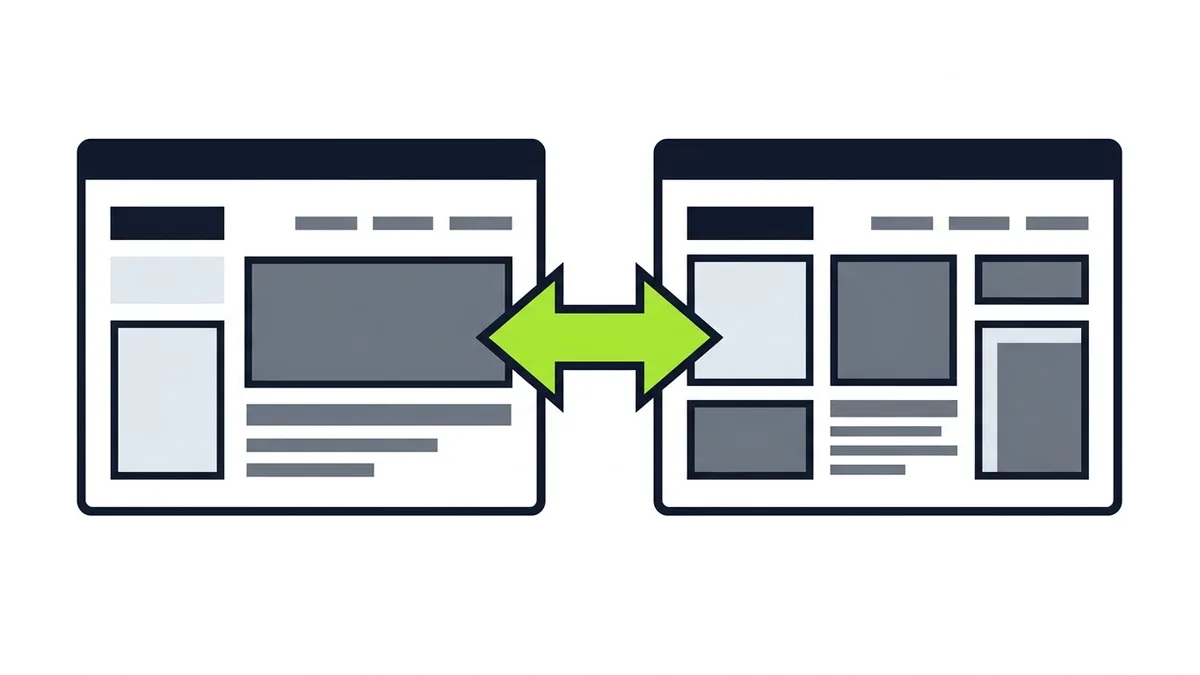
Two rules from Google's own documentation cover most of what a small business needs to know.
Rule 1: Google reads the language from the visible text. Google says it uses the visible content of your page to determine its language, and that it does not use code-level language information such as lang attributes, or the URL (Google Search Central, "Managing multi-regional and multilingual sites", accessed Oct. 2026). The practical meaning is simple. A page whose main text is English is an English page, no matter what the address or the code says. So the Spanish version needs to actually be in Spanish: the headline, the body, the buttons, the form labels. A page with a Spanish menu and English paragraphs is not a Spanish page. Give each language its own page, with its content written in that language.
Rule 2: Each version must point to the others. Google's guidance on localized versions is that each language version must list itself as well as all other language versions, and that if two pages do not both point to each other, the tags will be ignored (Google Search Central, "Tell Google about localized versions of your page", accessed Oct. 2026). These tags are called hreflang annotations. They are a way of telling Google "this page also exists in another language, here it is."
Keep expectations realistic. Hreflang is a labeling tool that helps Google connect the versions of a page, not a ranking boost. And because the pointing has to go both ways, a half-finished setup fails quietly: if the English page points to the Spanish page but not the reverse, Google ignores the markup.
For a small business, this means three things to ask your web developer or agency:
- Does every Spanish page have an English counterpart (or a deliberate reason it does not)?
- Do the pages reference each other in both directions?
- Is the content on each page truly in one language?
If you are building or rebuilding your site anyway, our website design service covers structure like this from the start. Planning it from the start is easier than retrofitting it, because otherwise every page has to be revisited.
Should the Spanish Version Be a Translation?
Not a literal one. A line-by-line translation keeps the English sentence structure and the English assumptions, and it often reads like a translation. A Spanish-speaking customer notices.
A better approach is to write the Spanish page for the person who will read it. That means:
- Use the words your customers use. Spanish varies by country and region, so ask your Spanish-speaking customers or staff what they call the service.
- Answer the questions that person asks. They may want to know whether someone speaks Spanish, how to reach you, or what happens at the first visit. Those answers belong on the page.
- Keep the facts identical. Hours, address, service area and offers must match the English page. Only the writing changes.
The same logic applies to ads. If you also run Spanish campaigns, read why translated copy is not a campaign, because the landing page behind the ad is the page you are building here.
What Should You Decide Before You Build?
Settle these points on paper first.
- Scope. Which pages get a Spanish version: the home page, your main services, the contact page, or everything? Starting with the pages that bring people to you is a reasonable first cut.
- Who writes and who reviews. Name the person responsible for the Spanish text and the person who checks it.
- Who answers. Decide who handles Spanish calls, texts and form messages, and what the form says about languages.
- How visitors switch. Plan a visible language switch on every page, and have it lead to the matching page in the other language, not always to the home page.
- How the pages connect. Agree that each page and its counterpart point to each other in both directions, as described above.
- How updates happen. Decide that any change to hours, prices or services is made in both languages together.
Skipping step 3 is the most common way a bilingual site disappoints its owner. The page brings in a Spanish message, nobody replies in Spanish, and the project looks like a failure when the website itself was fine.
If you are also weighing the budget side of a site project, our guide to small business website design cost explains what drives the price. We do not quote a figure for the second language here, because it depends on how many pages you translate, who writes them, and how you maintain them.
What Mistakes Do Bilingual Sites Make?
A few patterns show up again and again.
- Translating only the menu. The navigation is in Spanish, the content is not. Google reads the visible content, so the page is still an English page, and visitors feel misled.
- One-way links between versions. The English page points to the Spanish page, but not the reverse. By Google's own rule, pages that do not point to each other have their tags ignored.
- Mismatched facts. The English page says one thing about hours or services and the Spanish page says another. This is a trust problem and an operations problem.
- No one to answer. The page invites Spanish-speaking customers to get in touch, and the business has no way to reply in Spanish.
Frequently Asked Questions
Should a local business have a bilingual website?
It depends on your customers and on your ability to serve them. If a real share of your customers is more comfortable in Spanish, and you can answer them and keep that version accurate, a bilingual site can make sense. If you cannot do both, fix that first.
Will a Spanish version of my website increase my sales?
We cannot promise that, and no source we trust measures it for local service businesses. Public data shows that many people prefer information in their own language, but those are stated preferences, not results from businesses that added a language.
How does Google know which language a page is in?
Google says it uses the visible content of the page to determine its language, and that it does not use code-level language information such as lang attributes, or the URL. Write each page fully in one language.
What is hreflang and do I need it?
Hreflang is markup that tells Google a page also exists in another language. Google says each language version must list itself as well as all other language versions, and that if two pages do not both point to each other, the tags will be ignored. It labels the versions. It does not boost your ranking.
What Should You Do Next?
Look at who actually contacts you today, and write down how many of those contacts come in Spanish. Then answer the three questions from earlier: is there an audience, can you serve them, can you maintain the pages. If the answers are yes, plan the scope, the writers, the switch and the two-way links before a single page is built.
Etuos brings more than 10 years of digital marketing experience to local businesses. If you want to talk through whether a bilingual site fits your business, send a message on WhatsApp and tell us who your customers are. We offer a free diagnosis with no deadline. You can also reach us on the contact page.
Sources
- Google Search Central, "Managing multi-regional and multilingual sites", retrieved Oct. 2026, https://developers.google.com/search/docs/specialty/international/managing-multi-regional-sites
- Google Search Central, "Tell Google about localized versions of your page", retrieved Oct. 2026, https://developers.google.com/search/docs/specialty/international/localized-versions
- U.S. Census Bureau, "Most Americans Speak Only English at Home or Speak English 'Very Well'", 2023, https://www.census.gov/newsroom/press-releases/2023/language-at-home-acs-5-year.html
- Pew Research Center, "US Hispanics' consumption of English- and Spanish-language news", Mar. 2024, https://www.pewresearch.org/journalism/2024/03/19/english-and-spanish-language-news-consumption-among-hispanics/
- CSA Research, "Can't Read, Won't Buy - B2C", 2020, https://csa-research.com/l/media/Consumers-Prefer-their-Own-Language