
Your Customers Do Not All Search in English: Multilingual Marketing for Local Businesses
2026-10-01 · by Lin Zeri
Picture two neighbors on the same street in Houston. One types "house cleaning near me" into her phone. The other types "limpieza de casas cerca de mí." Same need, same zip code, same budget in mind. Only one of them sees your business, and you will never know the second one existed.
Most local marketing in the United States is built as if every customer searches in English. Owners know their town is more mixed than that. They hear Spanish at the counter, Portuguese on the phone, and a third language in the parking lot. But the ads, the website and the Google Business Profile are still written for one audience.
The usual fix is a quick translation. It rarely works, and the reason is not the grammar. It is that a different customer asks different questions, worries about different things and trusts different signals. This article is about those three differences and how to build around them without doubling your budget.
Key Takeaways
- About 78% of Americans age 5 and older speak only English at home (U.S. Census Bureau, 2023, accessed Oct. 2026). Roughly one in five does not, and your next customer may be one of them.
- Translated ad copy is not a Spanish campaign. Search terms, objections and trust signals differ, so the keyword list, the message and the landing page all need their own work.
- Google is retiring language targeting in Search campaigns and will rely on the language of the ad and the landing page (Search Engine Journal, 2026, accessed Oct. 2026). The language of your assets is now the targeting.
- A Spanish ad that rings an English-only phone line wastes the click. Fix who answers before you spend on who clicks.
Who Is Actually Searching in Your City?
Start with the national picture, because it is the one number you can check. In the Census Bureau's 2018 to 2022 American Community Survey, 78.3% of people age 5 and older spoke only English at home. Among those who spoke another language, 61.1% spoke Spanish (U.S. Census Bureau, 2023, accessed Oct. 2026). That leaves about one in five Americans using another language at home, and most of that group speaks Spanish.
Those are national figures, not your zip code. Your own area can look very different, and the Census Bureau publishes language tables for many cities and counties, so you can look up your own market. Do that before you spend anything. A neighborhood-level read beats any national average.
One more detail from the same release matters for how you think about this audience: 61.0% of Spanish speakers spoke English "very well." Read that carefully. It does not say they prefer English. It says the ability to use English is not the same as the choice to use it. A person who can order lunch, fill out a form and take a call in English may still search for a plumber in Spanish, because that is the language they use at home and with family, where recommendations travel.
Pew Research found a similar pattern in media habits. In 2024, 54% of US Latinos got news mostly in English, 21% mostly in Spanish and 23% in both about equally (Pew Research Center, 2024, accessed Oct. 2026). That is a news habit, not a buying habit, so treat it as a hint and not a rule. The hint is useful, though: the same person moves between languages depending on the context. Your marketing has to be there in each one.
So the first question is not "should I translate my website?" It is "which languages are my customers actually using when they look for a business like mine, and in which neighborhoods?"
A Translated Ad Is Not a Spanish Campaign
A translated ad takes your English headline, runs it through a translator and publishes it. A Spanish campaign starts from the customer. It asks what a Spanish-speaking customer types, what stops them from calling and what convinces them to trust a stranger with their home or their car. Those three answers change the work in three places.
The search terms are different
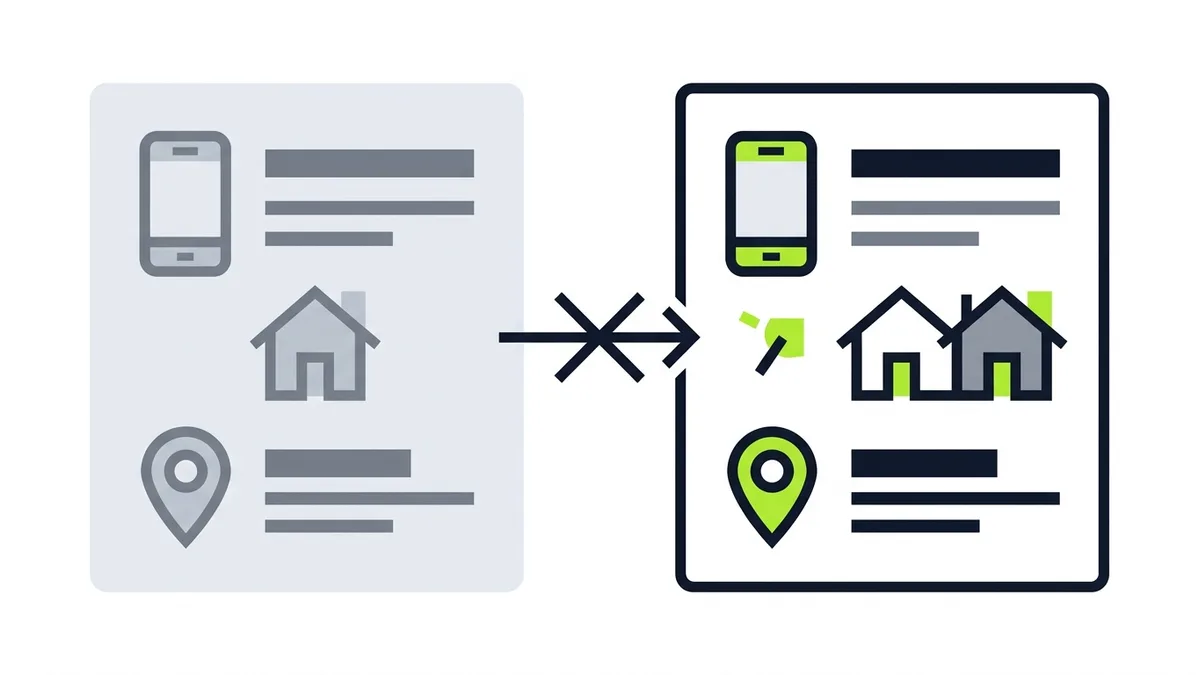
Take the opening example. "House cleaning near me" and "limpieza de casas cerca de mí" are not the same query in two languages. They are two queries with different phrasing, different local words and often a different set of competitors. People searching in Spanish may use terms that vary by country of origin: the word for a car repair shop, a roofing job or a small-claims lawyer is not the same in Mexico, Colombia and Puerto Rico. A direct translation of your English keyword list will miss many of the phrases people actually type.
The same goes for Portuguese. "Encanador perto de mim" is a separate search from "plomero cerca de mí," and a Spanish campaign does not cover it. In places with a large Brazilian community, that is a distinct audience with its own search habits.
Here is the practical version. Build the Spanish keyword list from scratch, with a native speaker, instead of translating the English one. Look at the search terms report in Google Ads after the campaign starts and add the phrases people really use. Treat Spanish and English as separate ad groups with separate performance data, so you can see what each one costs per lead and decide on facts. If you have never priced a campaign, the guide to paid advertising for your local business explains how the budget logic works.
There is also a platform change worth knowing about. Google announced in August 2026 that it is retiring language targeting in Search campaigns. Instead, "Google will rely on the language of the creative and landing page," and it will also draw on what it already knows about the languages a user speaks (Search Engine Journal, 2026, accessed Oct. 2026). The same article tells advertisers to make sure ads and landing pages use the intended languages, especially in multilingual campaigns.
For a local business, that has a simple consequence. If your Spanish ad points to an English-only page, you are sending mixed signals, and the customer will feel it too. The ad, the page and the call-to-action should all speak the same language from the first line to the last.
The objections are different
Every service has a moment where the customer hesitates. In English, the hesitation is usually about price, timing or whether you are better than the next listing. For a Spanish-speaking customer, the hesitation can include something earlier: "Will they understand me? Will they treat me fairly? Is the price going to change when I am not looking?"
Those are worries about being understood and being treated honestly, and an ad has to answer them before the click. That is a different kind of copy. A translated "Get a free quote today" does not touch any of them. A line that says a Spanish speaker will answer the phone, that the estimate is explained in plain words and that the price is agreed before work starts does.
A caution here: do not promise what you cannot deliver. If nobody on your team speaks Spanish yet, do not write "hablamos español." Fix the staffing first, as the section on the phone line below explains. The most expensive mistake in this whole topic is a promise that the first call breaks.
You will learn the real objections fastest by listening. Ask the Spanish-speaking customers you already have why they chose you and what almost stopped them. Their answers are better copy than anything a template can give you, and they cost nothing.
The trust signals are different

Trust is where local marketing is won or lost, and it travels through different channels in different communities. Recommendations can move through family chats, WhatsApp groups, church or neighborhood circles and Facebook community pages. A review in the right language, from a neighbor, can matter more than a polished ad.
That changes what you build. Ask happy Spanish-speaking customers for a review and tell them they are welcome to write it in Spanish. Reply to reviews in the language they were written in. Add a short Spanish description to your Google Business Profile and keep your hours, services and service area identical in both versions. If you want the full checklist for the profile itself, the Google Business Profile optimization checklist covers it.
Reviews also carry weight in general. BrightLocal's 2026 survey found that 31% of US consumers would only use a business rated 4.5 stars or higher (BrightLocal, 2026, accessed Oct. 2026). That is a statement about the US population as a whole, not about any single language group, but it explains why a review profile that exists in only one language leaves the others without proof.
Finally, think about the small signals: a photo of the real team, a name and a face on the website, a phone number that answers in the right language, a business that shows up in the neighborhood and does not look like a template. These do not need translation. They need to be real.
The Front Desk Decides Whether Any of This Works

You can build a perfect Spanish campaign and still lose every lead if the call goes to a phone that nobody can answer in Spanish. The click is the cheapest part of the chain. The call, the quote and the appointment are where the money is made.
Before you launch in a second language, answer these questions honestly:
- Who picks up the phone, and can that person handle the whole first conversation in Spanish, including the price and the schedule?
- What happens to a voicemail or a text message in Spanish? Does a person answer it, or does it sit?
- Does your estimate, invoice or contract exist in a form the customer can read comfortably?
- If your crew or technician arrives and the customer speaks only Spanish, can someone explain the job?
If the honest answer to the first one is "nobody," start there. Hire or train one person, or route Spanish calls to a teammate who can take them. A small, reliable setup beats a large, broken one. Responsiveness matters on Google's own platforms too: Local Services Ads documentation warns that "If you regularly fail to answer calls or respond to messages, your ad ranking may be affected" (Google, "Getting started with Local Services Ads", Local Services Help, accessed Oct. 2026). That page is about one ad product, but the lesson applies broadly: the market rewards businesses that actually answer.
The same goes for WhatsApp. Many customers already use it every day, and a business that answers there in the customer's language earns trust quickly. If you add it as a contact option, commit to checking it, in both languages.
How to Start Without Doubling Your Budget
Going multilingual does not mean building two businesses. It means adding one layer at a time, in the order that costs the least and teaches the most.
- Look at your own data first. Count how many of your current calls, messages and reviews already come in Spanish or Portuguese. That is demand you are getting without trying. It tells you where to begin.
- Fix the front desk. Decide who answers in each language and how messages are handled. This costs time, not ad money.
- Add the language to your Google Business Profile. A second-language description, replies to reviews in the original language and consistent business details across both versions.
- Publish one real service page in Spanish. Not a machine translation of the English page. Write it for the Spanish-speaking customer, answer their objections and name the neighborhoods you serve.
- Start a small, separate Spanish ad group. Native keyword research, Spanish ad copy, Spanish landing page, Spanish call-to-action. Keep it separate so you can read its results on their own.
- Review and adjust. Check the search terms report, the calls you got and the quality of those calls. Keep what works, cut what does not and only then expand.
Notice what is missing from the list: a second website, a second brand and a second team. A single, well-built structure with language-specific assets inside it is enough for most local service businesses. If the Spanish ad group does not perform, you will know because it reports separately, and you can stop without having wrecked the English side.
For a deeper look at how the budget can be shared across languages, read our guide to selling in English, Spanish and Portuguese in the same city. It covers the structure of a bilingual campaign. This article is about the thinking that has to come before it.
What Changes From City to City
The right mix is local. Houston, Newark and Miami do not need the same plan, and neither do two neighborhoods in the same city.
In Houston, the question is usually which Spanish-speaking neighborhoods you serve and how your business speaks to them. Do not assume one "Hispanic audience": the customer's country of origin, age and how long they have lived here all change the words that work. The page on marketing for businesses in Houston gives the local context.
In Newark, check whether Portuguese speakers are a meaningful share of your customers. If they are, treat Portuguese as a separate language, not an add-on to the Spanish work. The page on marketing for businesses in Newark covers it.
These are starting points, not rules. Whatever the city, the first step is always the same: read the local market before writing a single ad. You can see how we work on the About page.
Frequently Asked Questions
Is a Spanish ad just my English ad translated?
No. The words people search, the worries they have before calling and the signals they trust are different, so the keyword list, the message and the landing page each need their own work. Translation is a useful last step for polish, not the starting point.
Do I need a separate website for Spanish-speaking customers?
Usually not. For most local service businesses, one site with a well-written Spanish service page for each core service is a better start than a second site. Keep the contact details and business information identical across both languages.
Should I hire a Spanish speaker before I run Spanish ads?
Ideally yes, or at least have a teammate who can take the first call and book the job. An ad that promises Spanish service and reaches an English-only phone line costs you the click and the customer's first impression.
How do I know if my area has enough Spanish or Portuguese speakers to bother?
Start with your own calls, messages and reviews, then look up your city or county in the Census language tables. If you already get inquiries in another language without trying, a small, separate ad group is a low-risk way to test the demand.
Will running two languages double my ad spend?
Not by itself. You can start with a small separate ad group for the second language and keep the rest of the budget where it is. Because the group reports on its own, you can see what it costs per lead and decide whether to grow it.
Your Next Move
The customer who searches in another language is not a special case you handle later. In many cities, that customer is a regular part of your market, and the business that speaks to them in their own words has far less competition for their attention.
Start small: listen to the customers you already have, fix who answers the phone and test one properly built ad group. Do not translate your way into a campaign.
Tell me which city you serve and how many of your current customers already reach out in Spanish or Portuguese. I'll tell you where a multilingual setup would pay off first and what the smallest useful version looks like. Free diagnosis, no deadline: send a message on WhatsApp.