How Local Businesses Show Up in AI Search Results (ChatGPT, Google AI Overviews)
2026-10-12 · by Lin Zeri
Someone with a leaking sink does not always scroll through ten blue links anymore. They ask their phone for a nearby electrician or plumber, read a short answer, and call. If your business is not in that answer, you never find out you lost the job.
This guide is for owners of local and service businesses who keep hearing "you need to show up in ChatGPT." It separates what is documented from what is guesswork. Nobody outside the AI companies can tell you exactly how these tools pick a business, and anyone who promises a mention is selling something. What you can do is get the things right that every tool, and every customer, checks before acting.
Key Takeaways
- Many Google searches already end without a click, and AI summaries make links even less likely to be clicked, so being visible inside the answer matters more.
- Nearly half of US adults used an AI tool to find a local business in the past month, according to a vendor survey.
- Almost all of those users verify the recommendation before acting, so your profile, website and reviews have to agree with each other.
- No one can guarantee a mention in ChatGPT or an AI Overview. Focus on accurate information, real reviews and a clear website.
What Changes When Searches Stop Ending in a Click?
Start with the shift in behavior, because it explains why this topic matters. SparkToro's clickstream analysis found that in the first four months of 2026, 68.01% of Google searches in the US ended without a click (SparkToro, 2026, accessed Oct. 2026). That figure covers all Google searches, not only local ones, so read it as a direction, not a local benchmark.
AI summaries push in the same direction. Pew Research Center, using real browsing data from US adults, found that users clicked a traditional result link in 8% of visits when an AI summary appeared, against 15% of visits when it did not (Pew Research Center, 2025, accessed Oct. 2026). Ahrefs, analyzing 300,000 keywords, found that an AI Overview correlates with a 58% lower average clickthrough rate for the top-ranking page (Ahrefs, 2026, accessed Oct. 2026).
Both studies describe general search behavior, not local searches specifically. The practical point still holds: if fewer people click through to a website, the information that appears before the click, your name, your reviews, your service area, does more of the selling.
Are People Really Using AI to Find Local Businesses?
Yes, and in large numbers. Yext, which sells local presence software and ran the survey itself, reports that "nearly half of all US adults (47%) used an AI tool to find a local business in the past month," based on 1,120 US adults surveyed in March 2026 (Yext, 2026, accessed Oct. 2026). It is a self-reported vendor survey, so treat the exact number with some care. The direction is hard to miss.
The more useful finding is what people do next. The same Yext report says 93% or more of AI users take at least one verification step before acting (Yext, 2026, accessed Oct. 2026). That figure counts any verification step, so do not assume the check is always a Google search. What it tells you is that an AI recommendation is usually a starting point, not the final decision.
That is good news for a small business. If the answer is a shortlist and the customer then checks, you get a second chance to win them: your profile, your website and your reviews. They all have to tell the same story.
What Can a Local Business Actually Control?
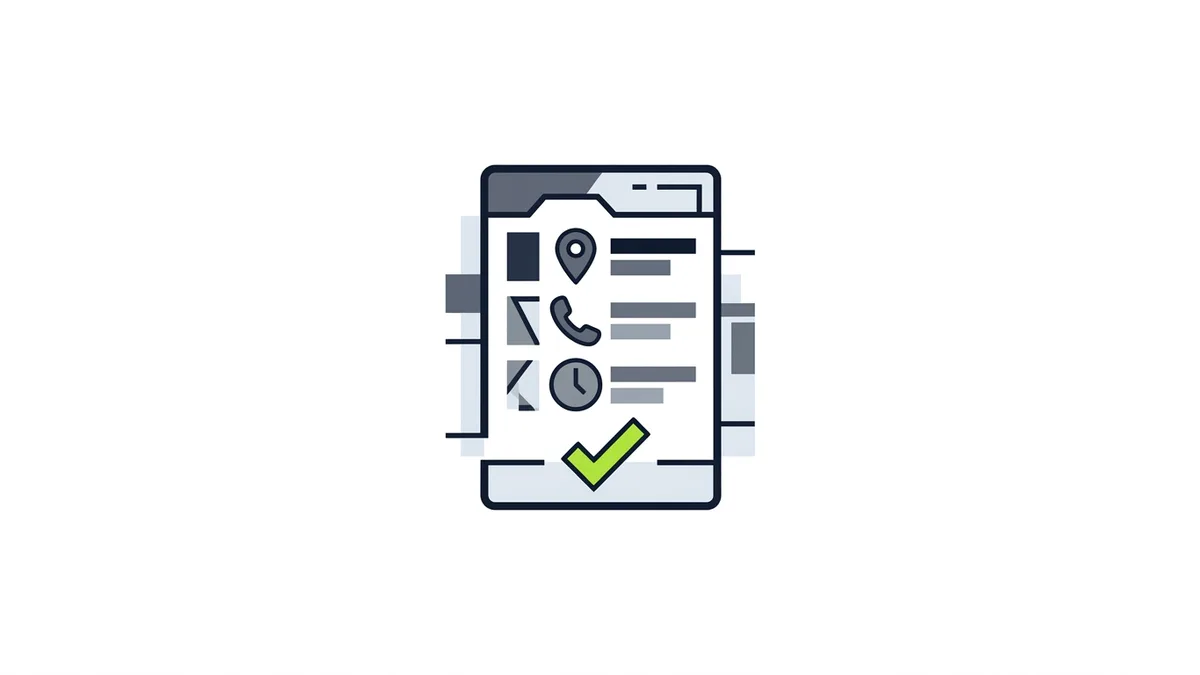
There is no public documentation of exactly how ChatGPT, Google's AI features or other assistants choose which local business to name. So this guide will not invent a formula. What is documented is how Google ranks local results, and that is the best place to start because Google's local data is where customers check you anyway.
Google says local results are mainly based on relevance, distance and popularity (the page later calls the third factor prominence). It explains that prominence means how well-known a business is, and that it is also based on "how many websites link to your business and how many reviews you have." It also states that "there's no way to request or pay for a better local ranking on Google" (Google, "Improve your local ranking on Google", Google Business Profile Help, accessed Oct. 2026).
Here is the part you control, in plain terms:
- Keep your business details identical everywhere. Name, address, phone number, hours and services should match on your Google Business Profile, your website, Yelp, Facebook and the directories you appear in. When a customer verifies an AI answer and finds two different phone numbers, trust drops.
- Describe what you do in specific words. Pick the category that fits your core business, and say on your website exactly which services you offer and which cities you cover. Vague pages give an AI summary, and a human, less to work with.
- Follow Google's profile rules. Service-area businesses should hide the address from customers, as Google's guidelines require (Google, "Guidelines for representing your business on Google", Business Profile Help, accessed Oct. 2026). Our guide on local SEO for service businesses covers the profile and website setup in detail.
- Give each service and each city its own page. A page written for one service in one city is easier to understand, and to quote, than a single page that lists everything.
To keep the line clear between what you can work on and what no one can promise:
| You can work on | No one can promise |
|---|---|
| Matching name, address, phone and hours everywhere | A mention in ChatGPT or an AI Overview |
| A Business Profile that follows Google's guidelines | A fixed spot in the local results |
| Specific service and city pages on your website | How an AI tool weighs one signal against another |
| Real reviews, with a reply to each one | When any change shows up in an answer |
Think of it as local SEO with a bigger audience. The work is the same, and AI search raises the cost of skipping it.
Why Do Reviews Matter Even More Now?
Reviews serve two jobs here. They are one of the inputs Google names for prominence, and they are what customers read when they verify a recommendation.
BrightLocal's 2026 survey of 1,002 US adults found that 41% now always read reviews when browsing for a business, and 80% say they are more likely to use a business that replies to all of its reviews (BrightLocal, 2026, via PinMeTo, accessed Oct. 2026). The same survey reports that 74% look for reviews written in the last three months, which makes freshness part of the picture, not only the star rating.
Behavior also spreads across sites. In BrightLocal's 2025 edition, 74% of consumers said they check at least two review sites before making a purchase decision (BrightLocal, 2025, via SearchLab Digital, accessed Oct. 2026). So one healthy Google profile is not enough if your Yelp or Facebook page is empty or contradicts it.
What to do:
- Ask every happy customer for a review right after the job, with a direct link.
- Reply to every review, positive or negative, in a calm and specific way.
- Never pay for reviews or trade discounts for them. It breaks platform rules and customers can tell.
Our guide on how to get Google reviews for a local business walks through the full process.
How Do You Check What AI Tools Say About Your Business?
Do a simple audit. It costs nothing and shows you what a customer would see.
- Ask ChatGPT, Google (including any AI summary it shows), and another assistant the questions your customers would ask, for example "best [your service] near [your city]" or "who can fix [your problem] in [your city]."
- Write down whether your business appears, which details are shown, and which competitors are named.
- Check every detail the answer gives about you against your real name, phone, hours and services. Wrong information is a signal to fix your listings, not to argue with the tool.
- Open the sources the answer points to, if any. Those are the pages customers will see next.
- Repeat on a regular basis. Results can differ by tool, by wording and by the person asking, so a single test proves little.
If you do not show up, do not panic and do not buy a "guaranteed AI ranking." Go back to the list above: consistent details, a clear website and a steady flow of real reviews.
What Should You Avoid?
A few traps are worth naming, because this topic attracts bold claims:
- Guarantees. No agency or tool can promise that ChatGPT or an AI Overview will name your business.
- Fake reviews and keyword-stuffed business names. They put your Google profile at risk and do nothing for the customer who verifies.
- Copying the same page for every city. Thin, repeated pages do not give anyone a reason to pick you.
- Ignoring the basics because AI is new. The customer who gets your name from an assistant still checks your reviews, your website and your phone number.
Where Should You Start?
Fix the foundation in this order: make your name, address and phone match everywhere, tighten your website's service and city pages, then set up a simple routine for asking for and answering reviews. If you want a professional to look at all of it together, that is what our SEO service covers.
Frequently Asked Questions
Can I pay to appear in ChatGPT or Google AI Overviews?
There is no documented way to buy an organic mention in an AI answer, and Google says there is no way to request or pay for a better local ranking. Be wary of anyone who sells a guaranteed mention. Focus on accurate information, a clear website and real reviews.
How do AI tools decide which local business to recommend?
The companies do not publish a full formula, so no one can give you an exact answer. What is documented is that Google's local results are mainly based on relevance, distance and popularity, and that customers verify recommendations before acting. Work on the things you can see and control.
Do reviews affect whether I show up in AI answers?
Google names reviews as part of how prominent a business is, and customers read reviews when they verify a recommendation. Whether any specific AI tool uses them is not documented, so treat reviews as a way to win the customer who checks, and as an input Google itself names for local ranking.
Is traditional local SEO still worth it?
Yes. The same profile accuracy, reviews and clear website content are what Google uses for local results and what customers check after an AI recommendation. AI search raises the stakes without replacing the basics.
How can I tell if AI tools mention my business?
Ask ChatGPT, Google and another assistant the questions your customers would ask, in your city, and note whether you appear and whether the details are right. Results vary by tool and by wording, so repeat the test now and then instead of relying on one try.
Want Someone to Check How You Look to Customers and AI Tools?
If you are not sure whether your profile, website and reviews tell the same story, tell us what your business does and where you want to be found. We offer a free diagnosis with no deadline: send a message on WhatsApp and we'll go through it together. You can also reach us from the contact page.